The Old Mill Court residential development in Sion Mills is up for a couple of prestigious built environment awards. Two weeks ago it was reported in UH that it was nominated for the Royal Town Planning Institute award for Planning Excellence. However it has also been short listed for a Social Impact Award along with a couple of other local buildings.
The Social Impact Awards are awarded by the Royal Institute of Chartered Surveyors (RICS) and they aim “to showcase how examples of the built environment can have a direct positive social and environmental impact on society”
In addition to the Sion Mills example, phase 1 of Strabane Academy and, the Northern Ireland Fire and Rescue Service Support Centre in Belfast, have also been placed on the regional shortlist. The winner for Northern Ireland is presently scheduled for selection in May this year with the grand final for the whole of the U.K scheduled to take place in September.
The Old Mill Court housing development is situated within an already well established residential area in Sion Mills. The presence of existing housing on the boundaries of a development site can present a challenge to developers as they try to preserve the existing residential amenity. The scheme comprises stand alone and terraced dwellings. The size and proportions of the houses are generally similar which helps to unify the scheme, but a variety in the use of finishes which include, rough render, red brick and black corrugated metal provides individuality.
The new Strabane Academy building opened its doors in January this year and has been described as a “state of the art” facility.
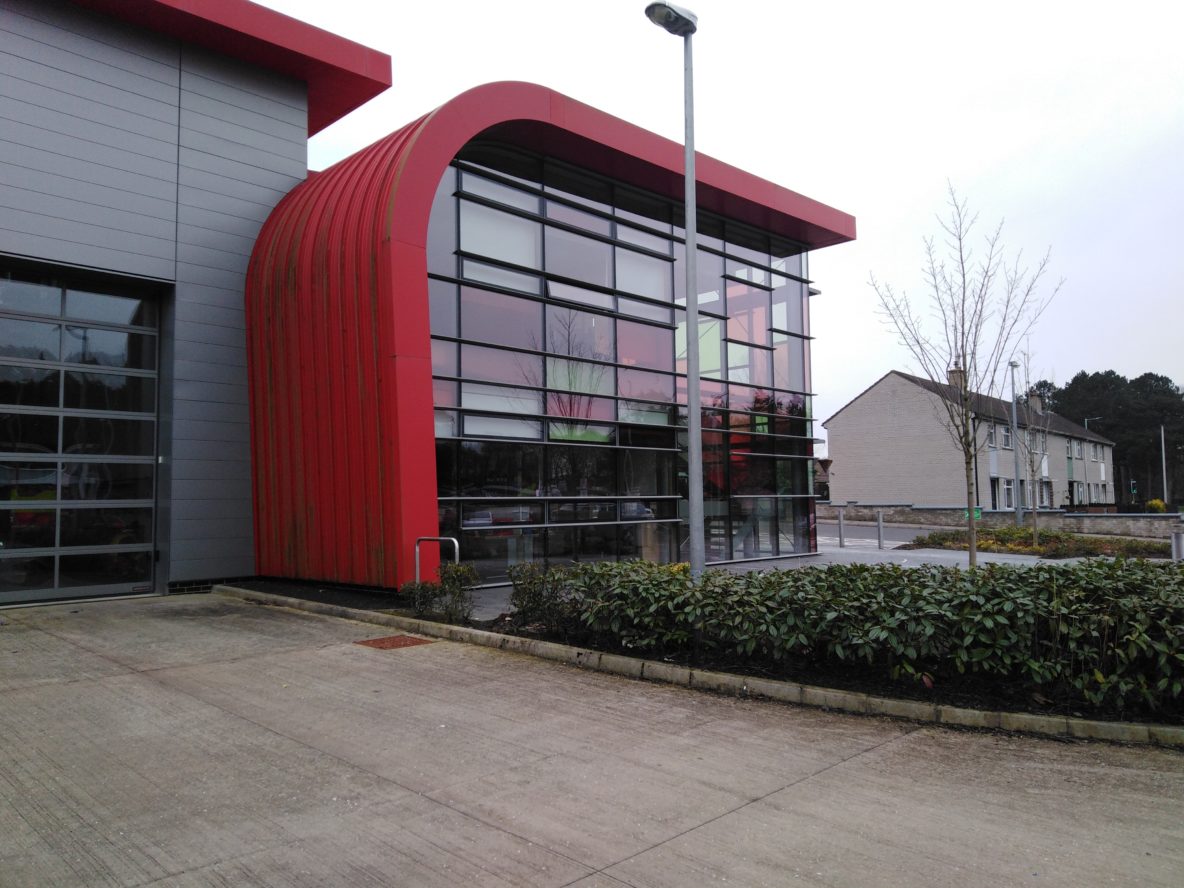
The design of the Northern Ireland Fire and Rescue Service building in Belfast actually takes its cue from the design principles set by the Omagh Community Fire Station which was completed in 2014. The Omagh Community Fire Station on the Killybrack Road was the first in a series of prototypical stations and which itself has received a number of awards.
The glass and bright red metal finish of the Omagh Fire Station provides a striking contrast against the soft grey brick of the houses beside it. However, whilst the colour and finishes of the fire station may be completely different from that of the neighbouring houses, it is sympathetic in scale, and so the effect is complementary and not overwhelming, with the reserved terraces of Gardenville holding their own.
In these times when buildings that we once frequented are now closed and our choice of diversions is restricted, it may be a good time to go out and take a walk (whilst you still may), look up and around you and perhaps see the buildings that you pass every day in a new light.