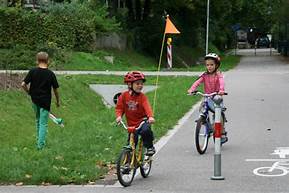
A recent study indicates that urban environments that work best for children work well for everyone. The design of our environments including the provision of and access to green spaces, parks and leisure facilities, can influence children’s levels of physical activity and improve their ability to negotiate their environment independently.
Government guidance indicates that children over five and young people should engage in moderate to vigorous physical activity for at least 60 minutes and up to several hours every day. Physical activity need not be limited to participation in formal sports or training, but the way in which our environment is planned and designed can also encourage regular exercise.
Planning that encourages car dependency may decrease children’s independence, levels of trust and physical activity.
A small child’s ability to explore its environment is generally limited to the area close to their home and for that reason it is considered that a child’s engagement with the environment needs to be examined firstly in terms of where he or she lives.
Play spaces beside the home need not be restricted to a private garden where there is limited opportunity for kids to have encounters with other children, but public footpaths and communal spaces should also be examined in terms of how they can accommodate safe and unsupervised activity. So for example the possibility for a child to be able to run freely from one end of footpath to the other without the chance of colliding with a car that has parked on the pavement.
As children get older they have a greater capacity and desire to explore beyond their home by themselves. Obviously children do not drive, and so the location of parks, corner shops, and leisure facilities relative to the home needs to be considered in terms of the distance that a child (depending on their age) would be expected to walk or cycle. This can be helped by mixed use developments and facilities for walking and cycling.
One expert came up with what they called the “ice lolly test”, which is basically an environment where it is feasible for a child to walk safely to the local shop by his or her self, buy an ice lolly, and get home again before the lollipop had melted. What this means is that not only is the local shop in close proximity to where people live, but also that the walking route in between is considered safe enough for children to use.
Many facilities will be further away from residential areas and this is where the intervening environment becomes so important. Walking routes that are perceived by parents as being safe by benefiting from natural surveillance, good lighting and minimal conflict with road traffic, allow children to negotiate their environment independently. With more independent mobility, children have greater opportunities for social interaction, to stay physically active, and to discover their world for themselves.